
 中文
中文News

On the morning of June 24, local time, CGN Uranium Resources Swakop Uranium (hereinafter referred to as "Swakop Uranium") held the Phase II Donation Event of the Hope Farm Project in the Omaheke Region, Namibia. The event was attended by Peter Shinidima, representative of the Prime Minister of Namibia and Executive Director of the Office of the Prime Minister; Sagaria Muheua, representative of Namibia's Ministry of Agriculture, Fisheries, Water and Land Reform and Deputy Director of Land Affairs for the Omaheke Region; and Pijoo Nganate, Governor of the Omaheke Region. Mr. Liu Haijun, Vice President of CGN Power, delivered a speech on behalf of the Group.
.png.png)
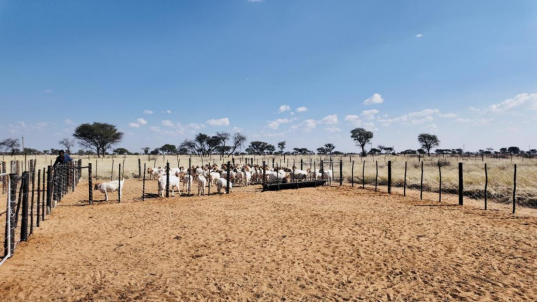
The total investment for Hope Farm Phase II is approximately 3 million Namibian dollars. In addition to the initial delivery of 104 quarantine-qualified lambs, the farm will simultaneously undergo infrastructure upgrading and renovation, including the refurbishment of 3 existing greenhouses and the construction of 1 new greenhouse; restoring wells and water storage dams, and laying a full-coverage irrigation system for 5 hectares of dryland; and building a full set of breeding facilities, including a new layer house, a livestock and poultry isolation and treatment area, a standardized rabbit house, and a goat pen. At the same time, the farm will also plant its first batch of cabbage and beet seedlings, contributing to vegetable supply to surrounding communities. Furthermore, the Swakop Uranium Foundation will renovate the elderly care home and kindergarten in the community where the farm is located through improving catering, lodging, medical care, and park supporting facilities, and Hope Farm will provide dedicated, customized fresh food ingredients to the two institutions.
.png.png)
Over the years, while operating the mine, Swakop Uranium has implemented various people's livelihood projects, empowering local people to pursue a better life with their own hands through a sustainable assistance model. Hope Farm is a vivid practice and warm testimony to these actions.
Goats Sustain Livelihoods: A Kindness Supports the Daily Life of Ordinary African Families
Julia Garus is a local elderly who carries the heavy responsibility of supporting a large family. The costs of her children's education and daily household expenses kept her worried day and night. In her early years, she raised a few head of livestock, which barely helped supplement her household income. However, an extreme drought swept through the village, killing all of her livestock. Disabled, she could not perform heavy agricultural labor; overnight, she lost her means of livelihood and fell into a hopeless situation.
"Just when things were at their hardest, the sustainable development project 'Hope Farm' of Swakop Uranium reached out to help me." The project team delivered 21 goats that had completed vaccination and provided a full set of veterinary tools. Moreover, local agriculture graduates from the project team frequently visited her home to provide hands-on training in feeding, disease prevention, and breeding techniques, bringing the concept of sustainable breeding directly to her doorstep.
.png.png)
In view of her limited mobility, her children and grandchildren took the initiative to help with goat herding, watering, and general care of the flock. Through day-to-day labor, the children have also learned the meaning of responsibility and commitment; as the flock has gradually grown, the children's food supply and tuition fees are now steadily covered, and there is renewed hope for a life that once seemed bleak.
"When I had nothing, it was Swakop Uranium that looked out for me," Julia says, keeping the memory of this kindness that crossed mountains and seas close to her heart. She has already made plans to return quality breeding livestock once her flock is sufficiently large, passing on this support to the next family in need. This mutual aid cycle is the most straightforward embodiment of CGN's sustainable development philosophy: teach a person how to fish, so that warmth may endure.
A Quiet Shift in Mindset: From Subsistence Living to a Sustainable Local Industry
If Julia's story is one of breaking through to a new life, then the farmer Metusaleg Gariseb, supported by the project, has completed a transformation of his mindset from a traditional farmer to one engaged in scaled operation.
.png.png)
Metusaleg has been farming all his life; before participating in Hope Farm, he had only seven or eight cows and sheep at home, making it difficult to achieve any scale. Whenever the family encountered urgent needs such as medical bills or house repairs, they were forced to sell their livestock, trapping them for years in a cycle where they could barely make ends meet. From the "Hope Farm" project, he received 21 fine-breed lambs, and more importantly, gained access to comprehensive, systematic breeding training. From livestock feeding, selective breeding, and epidemic disease prevention and control to lambing cycle management, local agricultural officers have provided on-site guidance, fundamentally changing his extensive and passive traditional breeding model.
In the past, cattle and sheep were merely "supplies" to tide the family over in emergencies. Today, he views livestock breeding as an industry capable of long-term operation and stable income growth. He diligently maintains a livestock breeding ledger, applies refined management and care to livestock based on their condition, and steadily expands his herd size. He has pledged that when the time comes to return the animals, he will select the most robust and healthy breeding livestock to strengthen the community's livestock breeding foundation.
Hope Farm Renewed and Upgraded, China and Africa Jointly Advancing Toward a Sustainable Future
One person is assisted, and many benefit; one area develops, and all share in the results. This is precisely the consistent philosophy behind CGN's overseas operations: adhering to industrial development and community symbiosis, and advancing economic benefits and social responsibility in tandem. The Hope Farm project has grown steadily from its initial 1,008 sheep to more than 1,500 head today, fully proving that community development is by no means a short-term aid program, but a long-term commitment that requires persistent effort.
.png.png)
Peter Shinidima stated that the Hope Farm project is further proof of the deep and solid foundation of China-Namibia cooperation and its tangible development value. While conducting mining operations, Swakop Uranium continues to create development opportunities and enhance people's well-being locally. Today, this fertile land has become a representative example of how our two countries practice sustainable development and work together to advance modernization. He proposed that he looks forward to seeing such a development model replicated across Namibia, instilling greater confidence in the country's long-term development. The Government of Namibia will continue to increase support for this project, consolidating the sustainable development resilience.
.png.png)
In his speech, Mr. Liu Haijun stated that CGN has always treated the fulfillment of overseas social responsibility as a key component of the Group's internationalization strategy. We are committed to creating a model of sustainable overseas social responsibility fulfillment, a model of mutual benefit and win-win cooperation based on deep localization integration, and a bond of cultural friendship for people-to-people connectivity between China and Namibia. In the future, we will continue to root ourselves in Namibia, serve Namibia, and give back to Namibia, helping to drive local high-quality development through more public-benefit projects and benchmark projects like "Hope Farm," and continue to polish the gold-standard brand of China-Namibia friendly cooperation.
The mine has taken root in Africa, connecting the friendship between China and African countries. From the establishment of a single mine to multi-dimensional, coordinated development spanning industry, talent, livelihoods, and rural communities, the ten-year practice of the Husab Uranium Mine vividly embodies the China-Africa community with a shared future concept. It demonstrates that when Chinese enterprises go global, their mission extends beyond resource development. It is about joining hands with local communities to build together and share the fruits of development through sustainable development experience.
Building on a decade of development, Swakop Uranium is now embarking on a new journey guided by the "Husab +" philosophy. Looking ahead, the company will continue to uphold CGN's sustainable development and international operation philosophy, further deepening practical China-Africa cooperation. Through long-term, pragmatic, and heartfelt efforts, Swakop Uranium will walk side by side with the people of Namibia toward a new future of sustainability and shared prosperity.

