
 中文
中文News

At 9:16 AM on July 4, 2026, Unit 2 of CGN's Taipingling Nuclear Power Project successfully achieved its first grid connection and delivered its first kilowatt-hour of electricity. This means that the second unit of the first "Hualong One" nuclear power base in the Guangdong-Hong Kong-Macao Greater Bay Area now officially possesses the capability to transmit electricity to the power grid, marking a key step toward the goal of commercial operation.
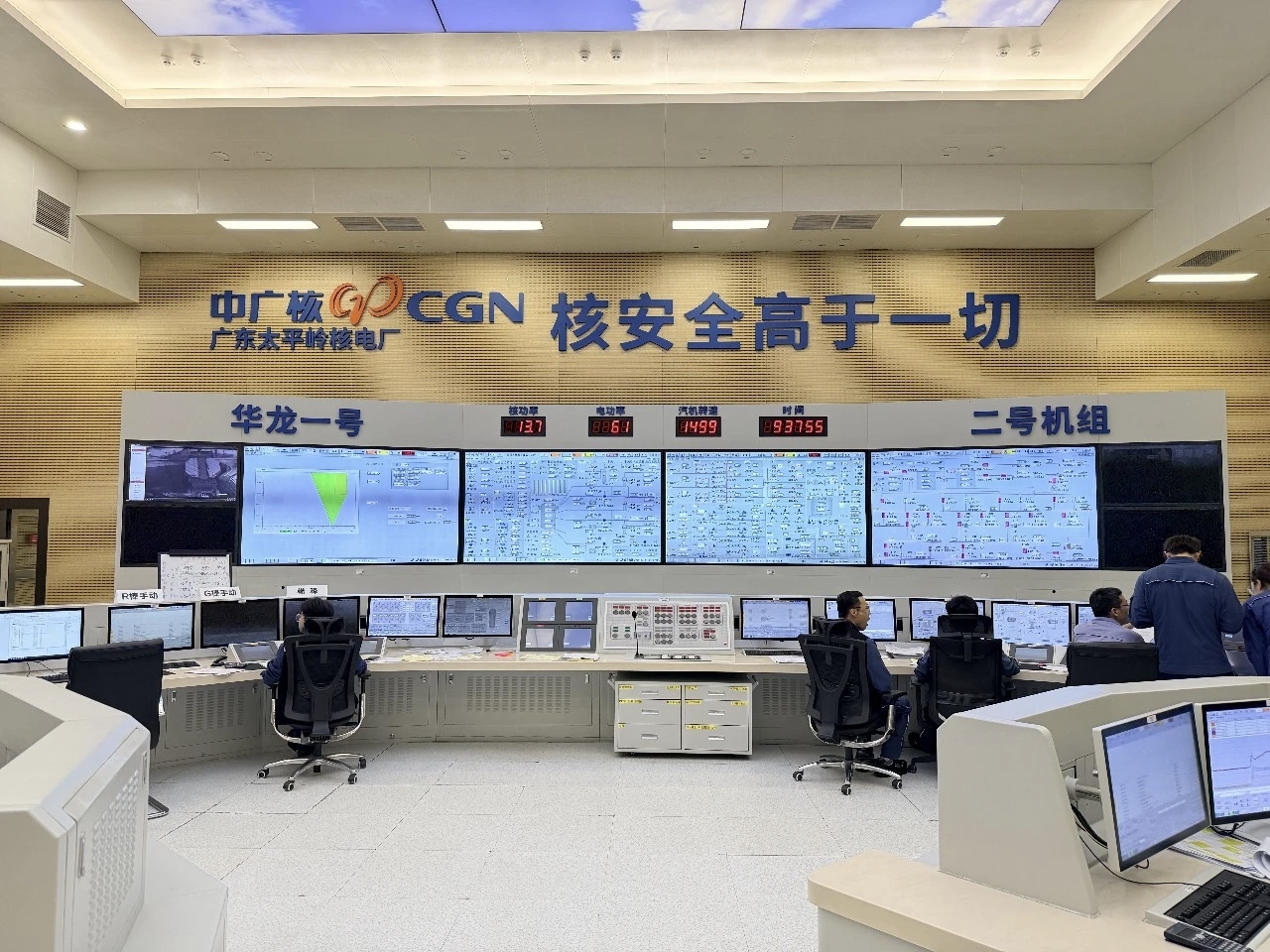
Construction of Unit 2 of the Taipingling Nuclear Power Project commenced on October 15, 2020. After on-site confirmation following the grid connection, the unit is in good operating condition, and all technical indicators meet design expectations. The unit will subsequently undergo a series of tests as planned to further verify its performance, and it is expected to be officially commissioned for power generation in the second half of 2026.
Based on the average annual utilization hours of domestic nuclear power in 2025, Unit 2 of the Taipingling Nuclear Power Project is expected to achieve annual power generation exceeding 9 billion kWh upon being put into operation, meeting the annual electricity needs for the production and life of nearly 1 million people and equivalent to reducing carbon dioxide emissions by about 8.4 million tonnes each year.
During the construction of Unit 2 of the Taipingling Nuclear Power Project, a series of digitalization and intelligent technologies were widely applied. The project successively promoted the application of intelligent equipment and systems such as Smart Construction Site 3.0, digital handover, and exoskeleton robots. It also implemented the first digital transformation project for spare parts management within China General Nuclear Power Corporation, empowering the full business process of nuclear power with intelligent solutions. In addition, the project continuously advanced process innovation and technology iteration, achieving new breakthroughs such as using mobile aerial work platforms for nuclear cleaning of the inner dome and polar crane, and optimizing the pressurization and depressurization rates of containment tests. It also promoted modularization and automatic welding processes, and for the first time in a Hualong One project, innovatively applied integrated hoisting technology for frustum modules and steel liner base plates, providing strong support for improving quality and efficiency in nuclear power engineering construction.

