
 中文
News

On September 24, 2026, CGN’s 2,000 MW Fanshi Offshore Wind Power Project in Yangjiang, Guangdong Province, achieved full-capacity operation, becoming China’s first new energy project to deploy 18 MW ultra-large offshore wind turbines on a large scale. The project also commissioned China’s first 500 kV intermediate reactive power compensation station at an offshore wind farm. It will accelerate the high-quality development of China’s offshore wind sector toward larger capacity and lower costs, injecting strong clean-energy momentum into the green and low-carbon transition of the Guangdong-Hong Kong-Macao Greater Bay Area.
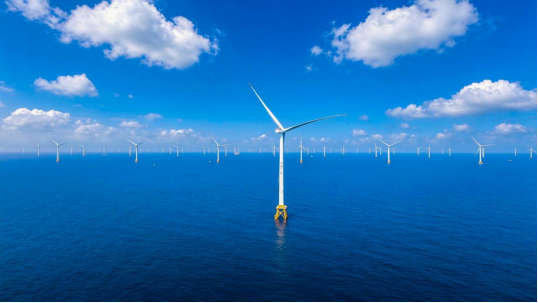
Located in the waters south of Nanpeng Island in Yangdong District, Yangjiang, Guangdong Province, the Fanshi Project comprises two 1,000 MW subprojects, Fanshi I and Fanshi II. The farthest point of the site is 81 kilometers from shore, with the maximum water depth of 53 meters, making it a flagship project in CGN’s development of nearshore deep-water offshore wind power. The project features 131 wind turbines, with 33 ultra-large 18 MW turbines, currently the largest single-unit capacity offshore wind turbine model deployed in batches in China.
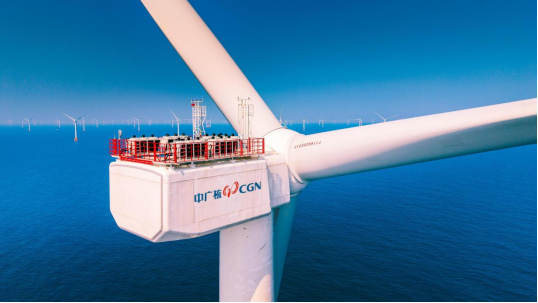
The 18 MW ultra-large offshore wind turbines deployed in this batch feature a rotor diameter of 292 meters and a swept area of approximately 66,000 square meters, equivalent to nine standard soccer fields. Operating at full capacity, each rotor revolution generates about 43 kWh of electricity, which is enough to meet an average household’s daily electricity needs for nine consecutive days, with a single turbine generating up to 56 million kWh annually. The batch application of this turbine model effectively reduces the number of turbine positions required, cuts the costs of submarine cable laying, offshore foundation construction, and sea-area occupation, and continues to drive down the levelized cost of electricity for offshore wind power.
Installing ultra-large components offshore in deep water is widely recognized as a major challenge in offshore wind construction. The Fanshi I offshore substation weighs 6,168 tonnes, while the total lifting weight of an 18 MW turbine exceeds 1,500 tonnes. These large and heavy offshore structures are highly sensitive to wind, placing stringent demands on vessel operations, component attitude control, and installation alignment precision.
To address a series of on-site challenges, including ultra-long-distance heavy-load transport at sea, component stabilization under wind and wave conditions, and millimeter-precision alignment, the project made the most of limited offshore operating time and successfully completed the marine transport and hoisting of large components for the Fanshi project. In doing so, it developed an integrated and replicable construction solution for ultra-large equipment under deep-water conditions.
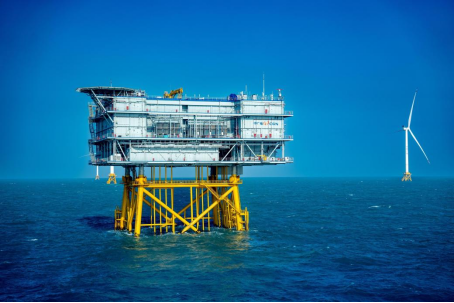
The significance of the Fanshi Project extends far beyond breakthroughs in ultra-large turbines and heavy-lift installation. As a key project of Guangdong Province and a critical component of the 10-GW-class offshore wind power base in western Guangdong, the project features China’s first 500 kV intermediate reactive power compensation station for an offshore wind farm. This pioneers a new model for the stable, long-distance grid integration of large-capacity wind power, and addresses industry-wide bottlenecks such as remote offshore locations, long transmission distances, and severe voltage losses that have constrained the stable grid connection of GW-scale offshore wind farms.
Upon reaching full-capacity operation, the Fanshi Project can deliver more than 6.6 billion kWh of clean electricity to the grid each year, equivalent to saving approximately 1.92 million tonnes of standard coal and reducing carbon dioxide emissions by about 5.1 million tonnes, and comparable to the afforestation of about 14,000 hectares of new forest. It will continue to optimize the energy mix of the Guangdong-Hong Kong-Macao Greater Bay Area and help Guangdong build a clean, low-carbon, safe, and efficient new power system. With the project in operation, installed offshore wind capacity in Yangjiang has surpassed 8 GW, making it the prefecture-level city with the largest installed offshore wind capacity in China.
Hu Guangyao, Secretary of the Party Committee and Chairman of CGN New Energy, stated that the 2,000 MW Yangjiang Fanshi Project serves as a key strategic anchor for CGN’s offshore wind layout and validates the reliability of domestic large-capacity turbines in complex marine environments. He added that CGN will continue to fulfill its responsibility as a clean energy enterprise and deepen marine energy technology innovation and engineering to support high-quality development of Guangdong’s marine economy, and contribute to China’s “dual carbon” goals.

