
 中文
中文News
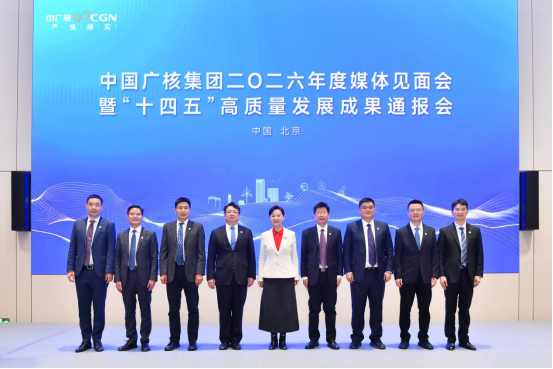
On January 27, CGN held its 2026 annual media briefing in Beijing, providing a systematic overview of its overall development in 2025 and its high-quality development achievements during the "14th Five-Year Plan" period. Li Li, Deputy Secretary of the CPC Committee and Director of the Group, attended the meeting and presented the group's high-quality development achievements. Guo Xingang, Director of the CPC and Public Affairs Department of the Group, presided over the meeting. Nearly 40 journalists from mainstream media and online new media outlets, including People's Daily, Xinhua News Agency, and China Media Group, attended and reported on the event.
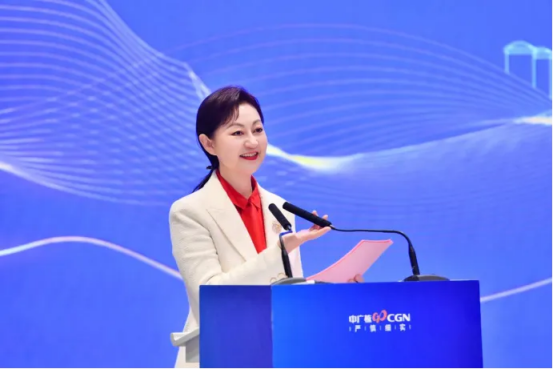
Li Li stated that 2025 marks the final year of the "14th Five-Year Plan." CGN has consistently followed the guidance of Xi Jinping Thought on Socialism with Chinese Characteristics for a New Era, fully implementing the guiding principles of the 20th National Congress of the Communist Party of China and the Second, Third, and Fourth Plenary Sessions of the 20th CPC Central Committee. The company has adhered to a safety-first approach, focused on its main responsibilities and businesses, and comprehensively deepened reforms, delivering outstanding results through solid work. In 2025, the group's operational installed capacity of clean energy exceeded 110 million kilowatts, with annual grid-connected power generation reaching 375.6 billion kWh. The group's tenth nuclear power base, Shandong Zhaoyuan Nuclear Power, officially commenced construction, with a total of six nuclear power units starting construction throughout the year, putting the large-scale development of Hualong One (HPR1000) on the fast track. In 2025, the newly added installed capacity of domestic new energy was 13.29 million kilowatts, injecting strong momentum into the green transition of the economy and society. During the "14th Five-Year Plan" period, the group achieved leapfrog growth in the scale of its clean energy installed capacity and operating efficiency, made breakthrough advances in critical core technology research and technological innovation capabilities, and realized a transformative improvement in development quality and industrial layout. Its core functions have been continuously strengthened, its core competitiveness has been significantly enhanced, and it has achieved solid results in fulfilling the "three roles" of technological innovation, industrial control, and safety support.
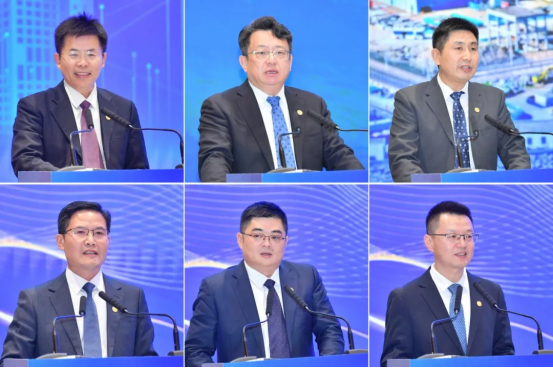
At the briefing, heads of six member companies—Ning Xiaoping from CGN Engineering, Hao Zhijian from CGN Suzhou Nuclear Power Research Institute, Zhang Helin from Fujian Ningde Nuclear Power, Chen Gongquan from CGN New Energy Holdings, Ouyang Zi from CGN Energy International Holdings, and Sheng Guofu from CGN Nuclear Technology Development—presented their high-quality development achievements during the "14th Five-Year Plan" period, covering areas such as nuclear power construction and operation, new energy development, international business expansion, and nuclear technology application. They also engaged in interactive exchanges with media reporters on topics including the batch construction of Hualong One (HPR1000), the achievements of digital transformation of nuclear power, domestic and overseas new energy development, and the business layout of smart ports.
The attendees jointly watched the group's annual video, "Every Kilowatt, Every Step." Through the inspiring stories of employees striving and forging ahead in various business fields, the video vividly portrayed the spirit of dedication, responsibility, and pursuit of excellence of CGN's people, resonating widely with the audience.
CGN's high-quality development achievements during the "14th Five-Year Plan"
10 newly launched nuclear power units during the "14th Five-Year Plan" period
18 Hualong One (HPR1000) units under construction simultaneously
During the "14th Five-Year Plan" period, CGN received approval for 16 nuclear power units, started construction on 10, and commissioned 4. To date, there are 28 nuclear power units in operation and 20 under construction, with a total installed capacity of over 56 million kilowatts.
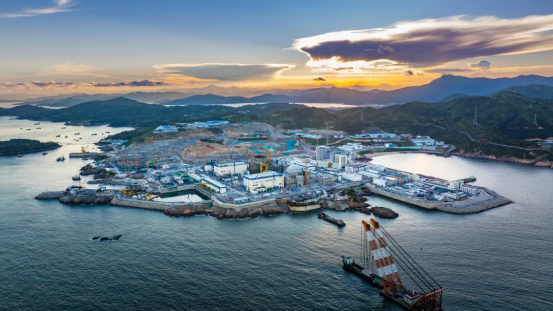
▲ Hualong One (HPR1000) construction site at the Zhejiang San'ao Nuclear Power Project
As a "national calling card" for China's nuclear power on the global stage, Hualong One (HPR1000) has 12 key technical indicators that meet the highest international standards. It has successfully passed the European Utility Requirement certification and the UK Generic Design Assessment, making it the only reactor type currently without any major review issues or unresolved concerns. Ning Xiaoping, CPC Secretary and Chairman of the Board of CGN Engineering, explained that CGN's Hualong One (HPR1000) demonstration project—Units 3 and 4 of Fangchenggang Nuclear Power in Guangxi—was commissioned with high quality in 2024, fully verifying the technology's safety, advancement, and reliability. Currently, 18 of CGN's nuclear power units under construction use the Hualong One (HPR1000) technology, putting batch construction on the fast track. By the end of 2025, CGN Engineering was constructing 22 units simultaneously, including providing design general contracting and equipment package services for the Huaneng Shandong Shidao Bay expansion project, demonstrating the spillover of its design and construction capabilities.
In the process of high-quality batch construction, advanced construction technology and digital methods have become key supports. During the "14th Five-Year Plan" period, 144 advanced construction technologies were implemented. Innovations such as the "smart construction site," the nuclear power version of the "building machine," the reactor pressure vessel insulation module, and the "emergency diesel generator plant large module" have pioneered new models of intelligent construction in nuclear power, significantly enhancing project efficiency and quality. Ning Xiaoping revealed that the Hualong One (HPR1000) technology is continuously being iterated and upgraded, with the Version 2.0 integrated innovation project soon to enter the demonstration project construction phase, which will comprehensively enhance its technological sophistication and overall competitiveness.
Meanwhile, CGN's operational nuclear power units have maintained a high level of safe and stable operation, with 82% of its performance indicators meeting world-class standards. Among them, Unit 1 of the Ling Ao Nuclear Power Station has been in continuous safe operation for over 7,000 days, repeatedly setting new international records for safe operation of similar units and becoming a "benchmark demonstration" in the global nuclear power operation field. Hao Zhijian, CPC Secretary and Chairman of the Board of CGN Suzhou Nuclear Power Research Institute, stated that through the independently developed "nuclear power key sensitive components information technology platform (iCCM)," CGN has installed "digital monitors" on major equipment for 28 units. This has shifted the operation and maintenance model from reactive maintenance to proactive prediction, providing core technical support for operational excellence.
Domestic new energy operational installed capacity exceeds 70 million kilowatts
Overseas business covers 18 countries and regions
During the "14th Five-Year Plan" period, CGN's domestic new energy achieved leapfrog development, with operational installed capacity exceeding 70 million kilowatts, nearly a threefold increase from the end of the "13th Five-Year Plan" period. The cumulative grid-connected power generation surpassed 370 billion kWh, and the equipment availability rate remained above 99%. In 2025, the newly added installed capacity of domestic new energy reached 13.29 million kilowatts, and its annual independent commissioning capacity has risen to the ten-million-kilowatt level.
Chen Gongquan, Deputy cpc Secretary and spokesperson for CGN New Energy Holdings, stated that to systematically address challenges such as stability, ecological synergy, and industrial expansion in the construction of the new-type power system, CGN has innovatively proposed and deeply implemented the "thermal-sea-green-sand-hydrogen" development strategy. This systematic practice has been selected as one of the "Top Ten Excellent Cases of Green Sustainable Development of Central Enterprises in 2025."
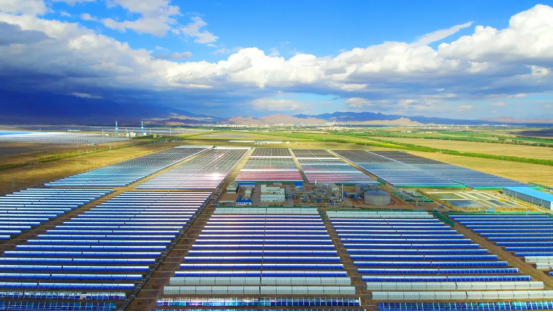
▲ Qinghai Delingha 50MW solar thermal demonstration project
In the solar thermal field, CGN adheres to technological leadership, leveraging platforms like the Qinghai solar thermal laboratory for continuous research and development. A new generation of large-aperture molten salt trough collectors has been developed and installed. Currently, the company's operational and under-construction solar thermal total installed capacity reaches 550,000 kilowatts, ranking among the top in the industry. Among these, the Delingha 50MW solar thermal demonstration power station, as China's first large-scale commercial project, achieved a record high in grid-connected power generation in 2025. Its utilization hours have ranked first in the industry for two consecutive years, providing the grid with a stable clean base load and peaking capacity.
In response to the strategy of building China into a nation with strong maritime capacity, CGN has been expanding its presence in the ocean. In 2016, it completed the Jiangsu Rudong project, the first "dual-ten" offshore wind power project in China, achieving several key technological breakthroughs and providing a complete set of technical and management experience for China's deep-sea offshore wind power development. Building on this foundation, during the "14th Five-Year Plan" period, CGN New Energy Holdings has continued its efforts, advancing offshore energy development towards integration and clustering. It successfully built the Huizhou Port project, the first million-kilowatt-level offshore wind power project in the Guangdong-Hong Kong-Macao Greater Bay Area; innovatively created "Fuxi No.1," the world's largest single typhoon-resistant wind-fish integrated cage platform; and the Shandong Zhaoyuan offshore photovoltaic project was selected as one of the "Top Ten Super Projects of Central Enterprises." These efforts are gradually building a "blue economy" industrial ecosystem with synergistic development of multiple business formats, including offshore wind power, photovoltaics, and marine ranching.
Photovoltaic sand control is a crucial pathway for the synergistic development of ecological management and energy. CGN has implemented a series of demonstration projects in Xinjiang, Inner Mongolia, and other regions, treating a cumulative total of over 200,000 mu of desert. The 500 MW photovoltaic sand control project in Luopu, Xinjiang, utilizes integrated technologies such as "sand film" to effectively treat 22,000 mu of desert, offering a replicable "CGN solution" and achieving a mutually beneficial outcome for ecology and energy through "power generation above the panels, sand fixation below the panels." The 900 MW integrated wind and photovoltaic project in Hinggan League, Inner Mongolia, has effectively treated 150,000 mu of desert, while the 820 MW photovoltaic project in Kubuqi has treated 34,000 mu. Additionally, the "Technical Requirements for Desert Photovoltaic Power Stations," drafted under the leadership of CGN, has filled a gap in both domestic and international technical standards.
In the layout of green power and hydrogen energy, CGN has built the first virtual power plant in China with a 100% green electricity supply. According to Chen Gongquan, over the past five years, the company's market-based electricity transactions have exceeded 210 billion kWh, with a cumulative green electricity trading volume of over 30 billion kWh, and CCER carbon assets sales surpassing 5 million tons. At the same time, CGN is actively positioning itself in future industries, having already built its first hydrogen production station and successfully developed a direct seawater hydrogen production prototype.
While deeply cultivating the domestic market, CGN's overseas green footprint is equally impressive. The installed capacity of new energy holdings of CGN abroad exceeds 13 million kW. During the "14th Five-Year Plan" period, the newly added installed capacity under construction and operational installed capacity is approximately 5.8 million kW. It has provided over 370 billion kWh of clean power to 18 countries and regions, bringing light to countless homes along the Belt and Road Initiative.
"We are deeply engaged in countries participating in the Belt and Road Initiative, actively integrating into international cooperation in the energy sector, and continuously exploring 'new paths, new scenarios, and new models' for clean energy cooperation in this process." Ouyang Zi, Deputy CPC Secretary and General Manager of CGN Energy International Holdings, explained that in Laos, the northern clean energy base has established a new collaborative path of "overseas resource development + cross-border power transmission." In Malaysia, a successful "agrivoltaics" pineapple plantation within the power station area has created a new demonstration scenario for the deep integration of power production and community development. And in South Africa, a customized direct green power supply scheme for the mining industry has pioneered a new model of precise adaptation through "mine-power integration." Ouyang Zi stated that CGN's overseas new energy development is transitioning from being a power station investor to a partner providing deeply localized energy solutions for partner countries.
R&D investment intensity reaches 3.8%.
New generation digital instrumentation and control platform for nuclear power achieves 100% domestic manufacturing.
According to Li Li, CGN continues to strengthen technological innovation, with an R&D investment intensity of 3.8% and a team of over 8,600 scientific and technological talents. During the "14th Five-Year Plan" period, CGN has accelerated the cultivation of strategic emerging industries and fully exercised its leading role in the industrial chain. To date, it has driven the high-quality development of over 17,000 upstream and downstream enterprises in the industrial chain, leading the comprehensive advancement of strengthening, supplementing, reinforcing, and reshaping the industrial chain for Hualong One (HPR1000), solar thermal, proton therapy, and other sectors.
One leading enterprise, several industrial chains, and the key element connecting them is technological innovation. Adhering to the major needs of the country and the development needs of the group, CGN has gathered its superior scientific research forces and established three major R&D platforms in the Guangdong-Hong Kong-Macao Greater Bay Area, the Beijing-Tianjin-Hebei region, and the Yangtze River Delta region, focusing on nuclear energy, new energy, and nuclear technology and digitalization, respectively, striving to create a source of original technology. The reorganization of the National Key Laboratory of Nuclear Power Safety Technology and Equipment has been approved and has entered into physical operation, and the "Nuclear Power Safety Digital-Intelligent Integration Innovation Platform" has received support from national major strategic implementation and key area safety capability construction projects.
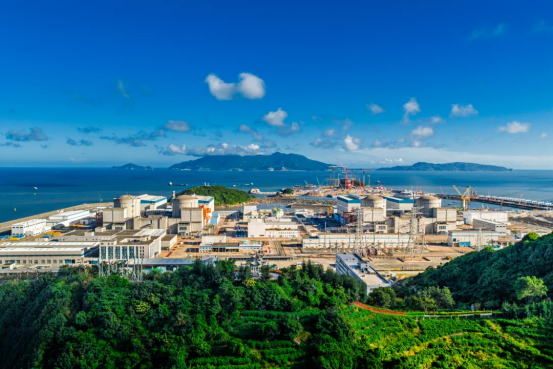
▲ Fujian Ningde Nuclear Power Base
Continuous R&D investment and platform construction have given rise to numerous technological innovation achievements. Zhang Helin, Deputy General Manager and spokesperson for Fujian Ningde Nuclear Power, stated that the company, taking the opportunity of being selected as a digital transformation pilot by the State-owned Assets Supervision and Administration Commission of the State Council and the National Energy Administration, has created the industry-leading "Ningde Nuclear Parallel System." This system integrates more than 10 million data points, enabling real-time linkage across all scenarios of equipment operation and maintenance. It has already issued warnings and identified over 320 potential hazards, reducing unplanned equipment downtime by 35%. The pioneering "3D smart screen" upgrades maintenance guidance from blueprints to 3D animations, saving over 4,400 work-hours annually. Additionally, through the application of technologies such as intelligent inspection robots and AI meter reading, equipment inspection efficiency has increased by 40%, significantly enhancing O&M safety and efficiency.In the field of digital technology, the independently developed nuclear-grade digital instrumentation and control platform "Hemu System," after breaking foreign monopoly, has been widely applied in 33 nuclear power units, including Hualong One (HPR1000), VVER, and high-temperature gas-cooled reactors, covering all reactor types and technical routes for second-, third-, and fourth-generation nuclear power. It is worth mentioning that after 7 years of R&D, CGN has achieved 100% independent manufacturing of the domestically manufactured version of the "Hemu System," which was certified by the Ministry of Industry and Information Technology in 2025. At the same time, several industrial control systems independently developed by CGN, such as the L7000 wind turbine controller and "Hemu Guardian," have been applied in engineering projects in fields like new energy and aerospace, empowering the high-quality development of more strategic emerging industries with nuclear-grade technology.
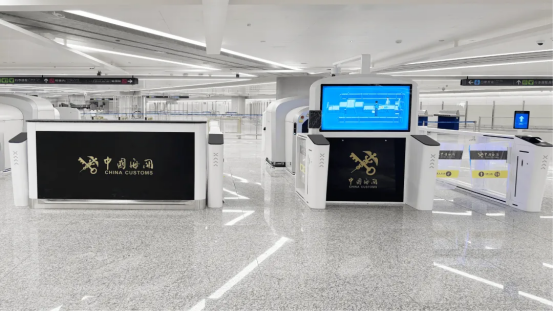
▲ CGN's "smart customs" security inspection equipment
In terms of nuclear technology application, Sheng Guofu, CPC Secretary and Chairman of the Board of CGN Nuclear Technology Development, explained that the company has established a full industrial chain layout covering the fields of industry, agriculture, medicine, environment, and security. In the healthcare sector, the "Hezhi" proton therapy system for treating tumors has reached an internationally leading level, effectively reducing the manufacturing costs of high-end radiotherapy equipment. The medical isotope production base built in Mianyang, Sichuan, produces "Hejia" brand isotope products that support the early diagnosis and treatment of tumors and cardiovascular and cerebrovascular diseases, enhancing the accessibility of diagnosis and treatment in domestic medical institutions. In the public security field, it has provided smart security inspection solutions for major projects such as the customs sealing of the Hainan Free Trade Port, the 15th National Games, and Guangzhou Baiyun International Airport, achieving "senseless customs clearance" and precise inspection through "AI + nuclear detection" technology. In terms of core components, it has achieved domestic manufacturing of high-performance silicon photomultipliers with a product yield exceeding 95%, successfully resolving a "choke point" issue.
Targeted assistance receives highest rating for seven consecutive years.
"Small but beautiful" projects benefit 30,000 people in Malaysia.
Li Li stated that CGN has always adhered to the philosophy of "building a project, boosting a local economy, and benefiting a community." It has received the highest rating of "Good" in the assessment of targeted assistance by central units for seven consecutive years, with a cumulative commitment of over RMB 760 million in grant-in-aid funds and the implementation of over one hundred major projects.
Domestically, CGN has deeply integrated its industrial advantages with rural revitalization, establishing a sustainable and socially responsible assistance model. In Leye, Guangxi, a wind power project has distributed nearly RMB 30 million in dividends to 63 village collectives, and "irradiation preservation" technology has helped increase the value of kiwi fruit. In Ningde, Fujian, the nuclear power base has guided surrounding villages and towns to invest in building camps and establishing enterprises, leading to the collective economic income of Baiyang Village growing from being in debt to exceeding RMB 13 million. This has achieved the "three major transformations" of villagers into workers, businesspeople, and shareholders, and Yujing Village has successfully transformed into a "gold medal tourism village." The "Egret Class" has been established in 31 classes across 12 schools in 5 provinces, benefiting nearly 4,000 students.
Overseas, CGN adheres to the "one country with one policy" approach, meticulously cultivating a series of "small but beautiful" responsibility brand projects. The Edra Scholarship Program in Malaysia has benefited 30,000 children; the Shimmer Plan in Laos integrates vocational education, donations for education, and agricultural support into a comprehensive responsibility initiative, with its Egret Class having already trained nearly two hundred technical professionals for the local community; the "From Wind Farm to Windmill" industrial tourism route in France has opened up sales channels for local agricultural products; and the Husab Marathon in Namibia, along with the "Lush Mountains and Lucid Waters Tour" for overseas bloggers from five countries, has been recognized as one of the top ten outstanding cases of Chinese enterprises' international image building for two consecutive years.

