
 中文
News
On the morning of August 21, a grand conference was held in Lhasa, Xizang Autonomous Region, to celebrate the 60th anniversary of the founding of the Xizang Autonomous Region. Xi Jinping, General Secretary of the CPC Central Committee, President of the PRC, and Chairman of the Central Military Commission, attended the conference. On August 20, while listening to the work report of the CPC Committee and Government of Xizang Autonomous Region, General Secretary Xi Jinping stressed that Xizang should fully implement the Party's strategy for governing Xizang in the new era, adhere to the general principle of seeking progress while maintaining stability, fully and accurately implement the new development philosophy, solidly promote high-quality development, and continuously and deeply focus on stability, development, ecology, and border security. Efforts should be made to build a united, prosperous, civilized, harmonious, and beautiful new socialist modern Xizang.
In the heart of the alpine grasslands of Gongbo'gyamda, Nyingchi City, Xizang, between rows of PV panels at CGN Gongbo'gyamda Photovoltaic Power Station, cosmos flowers spread their petals freely, while Meconopsis blooms push out fresh green beside gravel. Gazing across the Ali Plateau, the PV arrays at Shiquan River Power Station stretch out like silver armor, forming a picture of strength and grace together with snow-covered mountains and fluttering prayer flags — behind this scene of ecological and developmental symbiosis lies CGN's more than a decade of green practice rooted in the plateau. CGN has been cultivating the plateau for more than a decade, embedding clean energy projects into Xizang's development framework and contributing green power to the Xizang Autonomous Region's priorities of "maintaining stability, promoting development, protecting the environment, and strengthening border areas."
Securing Borders and Strengthening Defenses: Integrated Solar, Storage and Thermal Supply — Warming Border Areas and Winning Hearts
In Gar County, Ali Prefecture, at an altitude of 4,300 meters in the cold wind, the 50 MW concentrated solar power project under CGN's "Zero Carbon" solar-storage-thermal demonstration project is accelerating its growth: civil works acceptance has been completed, core equipment such as turbines and generators have been hoisted into place, and the relay of "solar thermal + photovoltaics + energy storage" is about to begin.
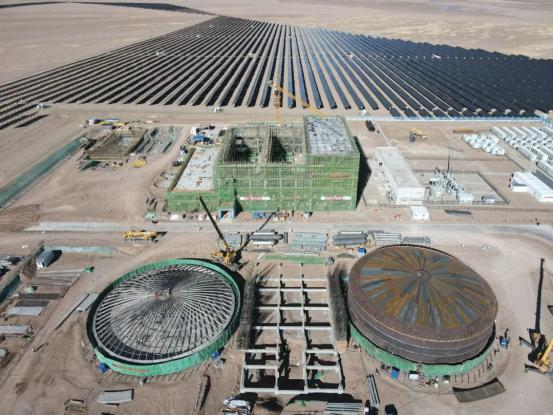
▲ The 50 MW concentrated solar power project under CGN's Ali "Zero Carbon" solar-storage-thermal demonstration project is under construction
As CGN's first high-altitude concentrated solar power heating project above 4,000 meters, it is also Xizang's first demonstration project adopting the "photovoltaics + molten salt electric heater + asynchronous interconnected energy storage" concentrated solar technology route. Since the start of construction, the project team has advanced steadily from one key milestone to another with the resolve to tackle tough challenges, relying on professional capability and firm determination. The project is expected to provide formal heating for Ali Prefecture during this year's heating season, bringing warmth to tens of thousands of border residents.
In the past, areas such as Ali and Shigatse often fell into a literal "cold winter" due to unstable power supply — herders burned cow dung for heating, which was smoky, polluting, and unsafe. Today, CGN's solar-storage power stations in Ali, Shigatse and other areas have helped improve local power supply reliability, turning 24-hour electricity in border areas from a dream into reality. More importantly, energy storage technology has eliminated reliance on daylight; surplus photovoltaic power generated during the day is converted into thermal energy, which continues to heat schools, hospitals, and homes at night.
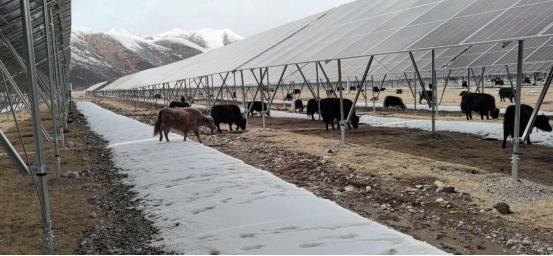
▲ CGN's Gongbo'gyamda solar-grazing complementary project in Nyingchi
Project construction has also become a bond for "securing borders and enriching the people.” Sang Mei, Secretary of the Party Branch of Songduo Village, Gongbo'gyamda County, Nyingchi City, introduced that CGN's solar-grazing complementary project in Gongbo'gyamda has not only brought rental income from land transfers, but also enabled more villagers to work nearby, put village trucks, loaders, and excavators to use, revitalizing surplus labor, land, and equipment. The project has created jobs for more than 130 local residents and generated over RMB 600,000 in labor income.
CGN's projects in Xizang have cumulatively provided more than 2,000 jobs, with Xizang youths trained to become photovoltaic operations and maintenance personnel, and herders transforming into "solar thermal managers." This flow of energy not only warms border lives but also strengthens the foundation of public trust.
Development Empowerment: Fifteen Years of Deep Cultivation Weaving a Plateau Clean Energy Network
In 2010, as one of the first central energy enterprises to enter Xizang, CGN laid its first photovoltaic panel on the alpine meadow in Sangri County, Shannan City. After fifteen years of deep cultivation, CGN has now outlined a clean energy map covering five cities (prefectures) in Xizang. On the "Roof of the World" with an average altitude of over 4,000 meters, CGN has written a legendary leap from "following" to "leading" in extreme environments by taking innovation as its pen.
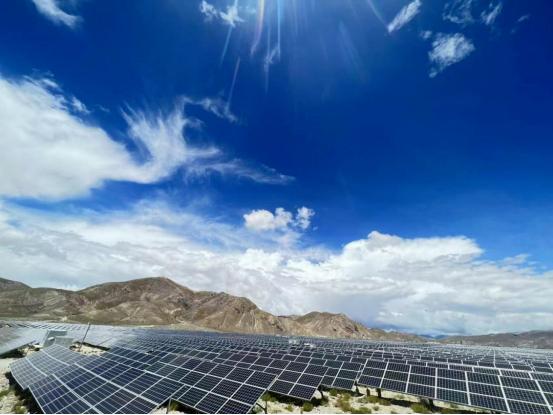
▲ CGN's Lhazê Photovoltaic Power Station
Among the photovoltaic arrays of the Lhazê Photovoltaic Power Station, a seemingly simple innovation embodies great wisdom — an elastic buckle mounting component developed by the Lhazê team of CGN New Energy Xizang Company has reduced the installation time of a single photovoltaic panel from 35 minutes to 12 minutes, improving efficiency by nearly three times. This seemingly small improvement has proven highly valuable in the blizzards of Xizang: tests show its wind resistance is more than double that of traditional components, and it remains "rock solid" even in severe cold of minus 15°C.To address the difficulty of battery replacement in plateau regions, the R&D team independently designed an auxiliary tool integrating a thermal conduction wrench with a hydraulic mechanism, reducing a task previously requiring three people and 30 minutes to a one-person job taking just eight minutes. Both technologies have been granted national utility model patents and have become standard configurations for photovoltaic construction on the plateau.
In 2025, CGN New Energy Xizang Company was approved to establish the "National Energy Solar Thermal Power Generation Technology R&D Center Xizang Research Laboratory," marking a new stage in CGN's layout in high-altitude solar thermal technology. The laboratory is focused on solar thermal power generation above 4,000 meters, concentrating on research in concentrating heat collection technology, parabolic trough collector testing and verification, and solar thermal power plant system integration and intelligent operations and maintenance talent cultivation, striving to build a "solar thermal+" industry–academia–research base.
Ecological Protection: Greening Barren Mountains to Paint a New Ecological Landscape on the Plateau
On the summer grasslands of Gongbo'gyamda, a unique ecological picture is unfolding: more than 50,000 photovoltaic panels are tilted towards the sun, glinting with metallic sheen, while beneath them, Gesang flowers and Meconopsis bloom freely, and herds of pikas forage and leap among them, forming an interesting contrast with the efficiently operating power generation equipment — this is the daily scene at the Gongbo'gyamda solar-grazing complementary photovoltaic power station, and a vivid footnote to the harmonious coexistence of plateau ecology and clean energy.
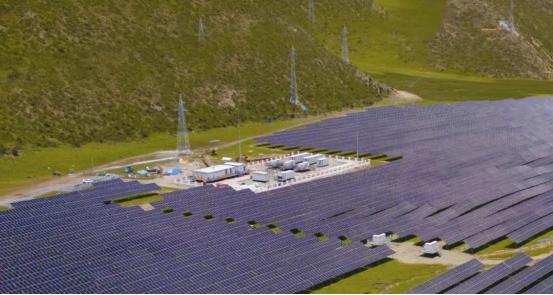
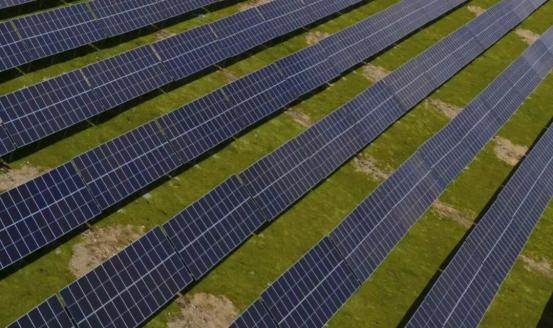
▲ CGN's Gongbo'gyamda solar-grazing complementary project
This pasture, once idle during the harsh winter, has now been revitalized under the "shade" of photovoltaic panels. The project engineering team has precisely calculated the spacing and tilt angle of the photovoltaic panels to maximize power generation while shading the pasture below from excessive ultraviolet radiation, extending the growth period of high-quality forage by nearly one month. “In the past, cattle and sheep could only graze on dry grass in winter. Now the grass under the photovoltaic panels is still green in November, so we no longer worry about feeding livestock through the winter," said local herdsman Basang. Basang's words capture the tangible benefits brought by the ‘solar above, grazing below' model. This innovative model not only doubles land use efficiency, but also achieves a closed-loop ecological industry chain of "power generation above, pasture below, and livestock nourished by the grass."
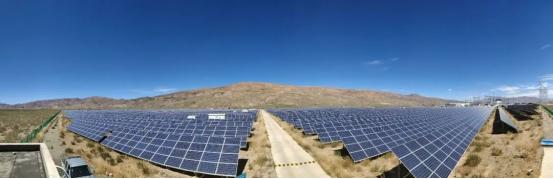
▲ CGN's Lhazê Photovoltaic Power Station
In the desert area of Lhazê County, Shigatse, CGN's photovoltaic arrays are rewriting history as "sand control guardians" against the encroachment of deserts. This area was once among the worst affected by wind and sand in Xizang, with nearly 100 mu of pasture swallowed by drifting sand each year. Since 2016, CGN has successively launched Phase I and Phase II of the Lhazê 50 MW photovoltaic sand control project, adopting a three-dimensional sand control model of "photovoltaic arrays + sand barriers + shrubs and grass planting" to stabilize drifting sand and nourish barren soil, protecting ecological vitality amid roaring winds and swirling sand. What is even more encouraging is that the shading effect of photovoltaic panels has lowered ground temperatures by 4–6°C and increased humidity, creating conditions for the natural germination of grass seeds. Now, former saline-alkali land has seen the emergence of native vegetation such as white grass and sheep grass, and occasionally, Xizang foxes and hares can be spotted.
In the Lhasa South–North Mountain Ecological Restoration Project, CGN's green action is equally remarkable. Since the implementation of the Lhasa South and North Mountains Greening Project in 2022, CGN has responded to the call of the Xizang Autonomous Region, participating in this green initiative with a high-level and high-standard approach. It has undertaken the afforestation tasks in seven zones of Bangdui Township, Dagzê County, covering a contracted planting area of 400.9 mu, and regularly carries out watering and maintenance, becoming a pioneering force in the journey of ecological development. This area, which once had a relatively fragile ecology, has been planted with native trees such as oil pine, sand willow, and sea buckthorn through concerted efforts, gradually forming a green ecological barrier.
United for Prosperity: Building Dreams Together, Composing a New Chapter of Flourishing Development
On December 12, 2022, when the 100 MW photovoltaic project of the Ali ‘Zero-Carbon' Solar-Storage-Thermal Power Demonstration Project was successfully connected to the grid, Xizang engineer Dorje's eyes welled up as he watched the pulsing current data on the monitoring screen. On this land with an average altitude of over 4,500 meters, he and his team used 30 photovoltaic matrices and 185,796 modules, spending countless days and nights to weave the "energy artery of the plateau."
Dorje clearly remembers that, at the start of the project, the plateau's extreme environment combined with communication barriers posed a dual challenge: at temperatures of minus 30°C, equipment piping was highly prone to freezing and cracking; strong winds carrying gravel continuously struck the supports of the photovoltaic panels; differences in language and living habits between Xizang and Han compatriots also created considerable obstacles to business communication. However, the Xizang Company team brought the sincerity of "sharing meals, living together, and working together," turning the construction site into a "classroom of integration." Han colleagues developed cold-resistant and insulation solutions, while Dorje, drawing on his knowledge of the plateau climate, optimized the layout of photovoltaic arrays to withstand wind and sand.
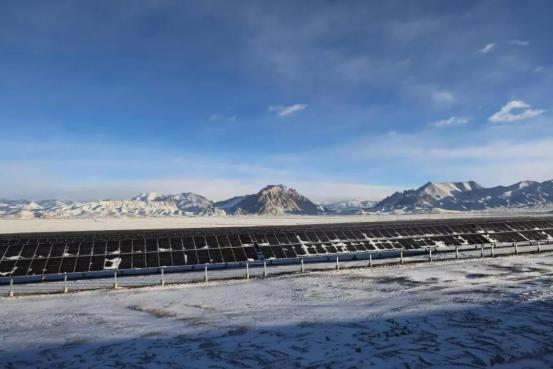
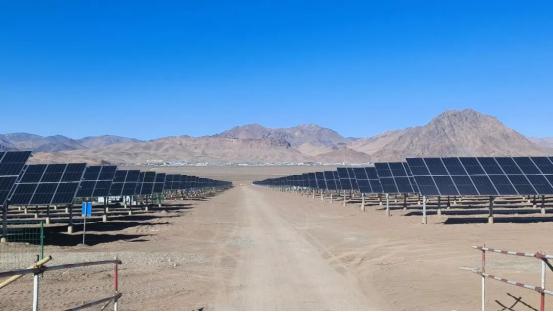
▲ 100 MW photovoltaic project under the Ali "Zero-Carbon" Solar-Storage-Thermal Power Demonstration Project
At the moment of grid connection, Dorje recalled scenes from his childhood when herders in his hometown could only rely on cow dung for heating in winter due to unstable heating supply. Today, the Solar-Storage-Thermal Power Project provides frontier communities with stable electricity 24 hours a day, and has nurtured more than 10 Xizang technical backbones, engaging over 200 local herder households in power station operations and maintenance.
"We are not only delivering electricity, but also fostering the seeds of sustainable development and the strength of ethnic unity," said Yi Jinyin, Party Branch Secretary of CGN New Energy Xizang Company. Yi Jinyin, CPC Branch Secretary of CGN New Energy Xizang Company, said. On the plateau's energy construction sites, hands from different ethnic groups clasp tightly together, supporting the hope of clean energy while weaving a close bond of ethnic unity.
From the warmth of improving lives and securing borders to technological breakthroughs that empower development, and from the green transformation in ecological protection to the united effort for common prosperity, CGN has shouldered its energy responsibilities to continuously inject momentum into Xizang's "Four Major Tasks.” In the future, the "solar-thermal landscape" on this plateau will continue to expand, writing more touching stories of green development.

