
 中文
中文News

On June 24, local time, CGN Uranium Resources Skorpion Company Limited (hereinafter referred to as "Swakop Uranium"), in collaboration with the Namibia Water Corporation, held the unveiling ceremony for the Erongo-Sunam Desalination Company in Windhoek, marking the official launch of the new desalination plant project. Tjitunga Elijah Ngurare, Prime Minister of Namibia; Lucie Masake, representing the Minister of Agriculture, Fisheries, Water and Land Reform; Modestus Amutse, Minister of Trade and Industry; Indileni Daniel, Minister of Environment, Forestry and Tourism; Natalia Goagoses, Governor of Erongo Region; and Wei Jinming, Economic and Commercial Counsellor of the Chinese Embassy in Namibia, attended the event. Mr. Liu Haijun, Vice President of China General Nuclear Power Corporation, delivered a speech on behalf of the Group.
.png.png)
The central-western coastal region of Namibia has an arid climate, where the supply-demand imbalance of freshwater resources has long been a prominent challenge. In recent years, amid Namibia's mining recovery and the advancement of new project plans—including the resumption of production at surrounding mines—regional water demand has continued to surge. Medium- and long-term water supply risks are becoming increasingly severe, persistently constraining the economic development of the central-western coastal region of Namibia. To break the bottleneck in water resource development, Swakop Uranium and the Namibia Water Corporation officially signed a joint venture agreement for the desalination plant in December 2025, with the support of the local government, to jointly develop and construct the seawater desalination plant.
Following the signing of the joint venture agreement, the unveiling of the joint venture company and the official launch of the project mark an important phased achievement in the joint efforts and practical cooperation between the Chinese and Namibian parties. The new desalination plant project is a strategic infrastructure construction project in Namibia, with a designed capacity of 20 million cubic meters per year. It is expected to be officially completed and commissioned for operation in 2028. Upon completion, the project will comprehensively ensure a stable water supply for production and daily life in the Erongo Region and surrounding areas.
The new desalination plant project is not only a core initiative to build a solid water resource security barrier for the region, but also a key project to boost Namibia's economic development. It will effectively attract investment in mining, energy, industry, and municipal supporting facilities in the Erongo Region, further increase local employment opportunities, and effectively drive improvements in local livelihoods, income growth, and industrial upgrading. The project not only highly aligns with "Namibia Vision 2030" and the Sixth National Development Plan (NDP6), but also demonstrates Swakop Uranium's responsibility and determination to assist Namibia in ensuring a stable water supply and empowering local sustainable economic development.
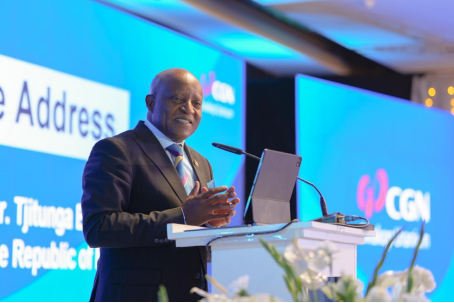
In his speech, Prime Minister of Namibia Saara Kuugongelwa-Amadhila pointed out that water security is critical to Namibia's economic development, social stability, and national security. The construction of the Erongo-Sonam Desalination Plant will become a cornerstone for Namibia's long-term sustainable development. This project is not only a strategic project for Namibia to implement its National Development Plan, but also a vivid testimony to the deep traditional friendship between China and Namibia. After the project is commissioned and operational, it will continuously improve the guarantee of people's livelihoods, broaden local employment channels, and improve the upstream and downstream industrial chain layout. The Government of Namibia will provide all-around support for the project's advancement, and hopes that the project teams from both China and Namibia will work in solidarity and cooperate to build, together creating a beautiful blueprint for win-win development between the two countries.
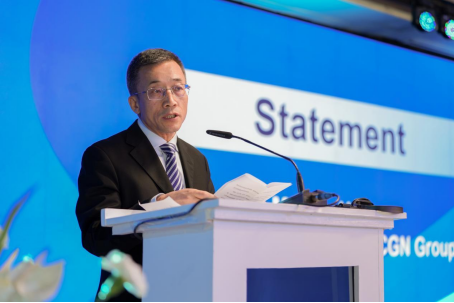
In his speech, Mr. Liu Haijun stated that during the 2024 Summit of the Forum on China-Africa Cooperation, the heads of state of the two countries deeply planned the blueprint for China-Namibia friendly cooperation and reached important consensus with a key focus on areas such as water resource security, improvement of people's livelihoods, and industrial synergy. The desalination project launched successfully today is a key project for deepening the all-weather strategic partnership between China and Namibia, a landmark achievement in China-Namibia mutually beneficial cooperation under the Belt and Road Initiative, and a pragmatic practice by Chinese enterprises to support Africa's water resources governance and implement the China-Africa community with a shared future concept. As a global leading clean energy enterprise, CGN will remain committed to rooting itself in Namibia, serving Namibia, and empowering Namibia. By advancing project construction to high standards and high quality, CGN will strive to build a quality project, a public-benefit project, and a benchmark project. Through tangible cooperation outcomes, it will ensure that the development of a China-Africa community with a shared future bears more fruitful results in Namibia.
At the event, the joint venture company pledged to spare no effort in promoting the implementation and construction of the project to achieve the established construction and operation targets. Meanwhile, the company will actively invest in local procurement, employment support, and talent development, fully stimulating industrial chain circulation, unleashing diverse economic value, and sharing development outcomes with the host country.
Looking ahead, CGN will continue to implement its brand building and social responsibility work arrangements. Throughout its internationalized operations, the company will actively fulfill its public welfare commitments, benefit surrounding communities and enterprises through project construction and operation, and contribute to socioeconomic stability. In doing so, it will vividly demonstrate the sense of responsibility of central state-owned enterprises and further deepen people-to-people connectivity between China and Namibia.

